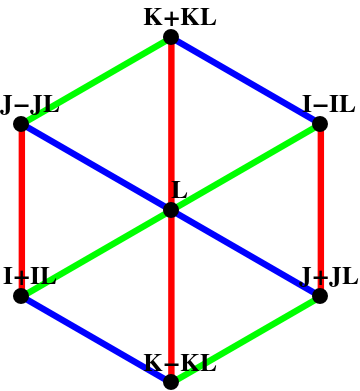
Section 1.5 The Cayley–Dickson Process
¶(This section was originally published in [1].)
We have constructed the complex numbers, the quaternions, and the octonions by doubling a smaller algebra. We have
We can emphasize this doubling, using a slightly different notation. A complex number \(z\) is equivalent to pair of real numbers, its real and imaginary parts. So we can write
corresponding in more traditional language to \(z=x+iy\text{.}\) Conjugation and complex multiplication then become
A quaternion \(q\) can be written as a pair of complex numbers,
corresponding to \(q=z+wj\text{.}\) Conjugation now takes the form
but what about quaternionic multiplication? Working out \((a+bj)(c+dj)\) with \(a,b,c,d\in\CC\text{,}\) we see that
so that
Finally, if we write an octonion \(p\) as two quaternions, corresponding to \(p=q+r\ell\text{,}\) we obtain
All of the above constructions are special cases of the Cayley-Dickson process, for which
where \(\epsilon=\pm1\text{.}\) We can use this construction to generate larger algebras from smaller ones, by making successive choices of \(\epsilon\) at each step.